

The third edition of the Content Management Systems Market Overview is being published this year. In the 2018 market overview, we compared 12 solutions, and in the 2019 market overview, 14. In 2020, we were able to convince even more providers to participate and present 17 enterprise CMS in this market overview. These are compared in 13 categories and based on over 110 criteria. This makes it much easier for you to orient yourself when selecting software. You can download the comparison as a PDF.
Enterprise Content Management Systems: The framework in which it all happens
Companies are communicating more and more with their target groups via the website and social media. The number of content channels has increased significantly. An important task for marketing managers is to manage the content produced, i.e. to ensure that it is distributed on different channels. It is important that the content is adapted to the specifics of each channel. Another crucial task is to ensure that existing content can be quickly replaced, updated or taken offline. Content management systems (CMS) provide the right framework and are an important part of the enterprise content technology stack. We compared 17 commercial solutions for you in the following categories:
- Market Overview Categories
- General information about the providers
- Industry focus of the providers
- User interface languages
- Basic functions of the solutions in comparison
- Advanced functions and features for handling content
- Interfaces
- Additional apps and plugins
- Additional functions of the systems
- Legal criteria
- SEO criteria
- Additional services of the providers
- Pricing of the systems
We have compared these enterprise content management systems:
BloomReach Experience Manager (brXM).
BloomReach is a Dutch company based in Amsterdam. 300 employees develop and sell the company’s software, which has been on the market since 1999 and is used by around 300 customers. In Germany, the company has offices in Munich, Berlin, Hamburg and Düsseldorf. USP (according to its own statement): „BloomReach Experience Manager is open (i.e., easy to integrate), offers increased agility for complex web environments and is Intelligent (thanks to AI-based personalization).“
censhare 2019.3
Munich-based censhare AG has been on the market with its product since 2002 and employs 270 people. The software is used by over 350 customers. USP (according to its own statement): „Holistic content management approach (incl. DAM, PIM, project, translation and variant management), based on a high-performance, semantic database.“
CONTENS CMS
The content management system of CONTENS Software GmbH has been around since 1999. With 35 employees, the company operates from Munich and takes care of its approximately 200 customers. USP (according to their own statement): „fast integration, simple usability, great flexibility, multilingualism, multi-client capability“.
Contentpepper
Contentpepper is a comparatively young company from Leichlingen in North Rhine-Westphalia. The solution has been on the market since 2016 and is used by 15 customers. The company employs 22 people. USP (according to their own statement): „Contentpepper is a modular platform that creates, manages and automatically distributes content for all digital channels. The headless API-first approach allows integration into any enterprise architecture, enabling an efficient (process) upgrade for digital marketing.“
Contentstack
Contentstack is the youngest solution in the comparison and is still very fresh in the German-speaking world. The company is headquartered in San Francisco (USA). In Europe, the company operates from its Amsterdam location. Contentstack has 150 employees and already more than 120 customers for its solution, which has been available since 2018. USP (according to its own statement): „Contentstack is a headless content management system that excels in usability for editors and end-users, not just developers. Contentstack is the most popular headless CMS in the market – see G2Crowd and Gartner Peer Reviews. Compared to traditional CMS systems, Contentstack stands out for its modern, microservice-based solution that significantly accelerates implementation in modern digital experience architectures. As a SaaS CMS, customers have the latest functionality at their fingertips – no more upgrades!“
CoreMedia Content Cloud
CoreMedia AG, based in Hamburg, Germany, employs 180 people and has been offering its software solution since 1996. The company has 330 customers. USP (according to their own statement): „CoreMedia Content Cloud offers you a complete platform for omnichannel content management (CMS) and digital asset management (DAM), with built-in eCommerce and marketing tool integrations and a secure, modular architecture. So you can innovate faster, increase editorial efficiency, and optimize ROI across all online channels.“
Episerver Content Cloud
Founded in Sweden, Episerver is now headquartered in Nashua, USA. Worldwide, 825 people are employed by the company. In Germany, Episerver operates from its location in Berlin. The solution has been available on the market since 2017 and is used by around 8,000 customers. USP (according to its own statement): „Our Azure-based and customer-centric content cloud offers marketers, merchandisers and editors the ability to easily target and scale content using true AI-based one-to-one personalization to enable the highest level of customer experience.“
eZ Platform DXP
Behind eZ Platform DXP is Cologne, Germany-based eZ Systems GmbH, which has been offering its software since 1999. The company has around 500 customers and employs 80 people. USP (according to their own statement): „The Digital Experience Platform (DXP) from eZ adapts to the trends and is well situated in a constantly growing customer experience market with an attractive opportunity in e-commerce. Especially when there is a need for a combined Content & Commerce Platform solution, eZ can be used. eZ can be seen as a unified DXP (Content Management, Personalization, Commerce, Application Development).“
FirstSpirit
FirstSpirit has also been live as a software solution since 1999. The company behind it is e-Spirit AG from Dortmund. The company from Westphalia employs 200 people and has 300 customers using its services. USP (according to its own statement): „With FirstSpirit Hybrid CMS, you create perfect Digital Experiences at any time and on any channel, ensuring a better user experience and stronger customer loyalty. FirstSpirit offers a comprehensive feature set for enterprise demands, best-in-class usability for users and developers, and best-in-class integration capabilities with any third-party systems.“
Imperia
Imperia is a solution from Cologne-based pirobase imperia GmbH. The company has had its solution on the market since 1995. pirobase imperia employs 95 people. Over 300 customers are using Imperia. USP (according to its own statement): „Headless content management even for large teams and editorial teams. Guided content creation through workflow wizards guarantees first-class content.“
InterRed
InterRed GmbH has been offering their solution since 1996. More than 10,000 customers are now using it. InterRed is based in Siegen and employs 60 people. USP (according to their own statement): „ContentHub solution – one CMS for all channels: Online, Print, App.“
LianaCMS
Liana Technologies has been offering its solution on the market since 2006. The Finnish company, headquartered in Oulu, employs 230 people. In Germany, Liana Technologies is located in Munich. Around 1,000 customers are using Liana CMS. USP (according to their own statement): „The development of LianaCMS is all about user and customer friendliness. That’s why LianaCMS consists of modules from which the appropriate ones for each project can be chosen. In this way, each implementation creates a unit that exactly meets the needs of the customer and does not contain unnecessary functions. Because of its modularity, LianaCMS can be used both for the websites of small companies and for the huge multi-sites of global corporations.“
Liferay DXP
The provider Liferay is a company headquartered in Diamon Bar, California (USA). In Germany, the company is located in Eschborn near Frankfurt a.M. The software has been available since 2004 and is currently used by 1,800 customers. Liferay employs 900 people. USP (according to its own statement): „Create a uniform appearance of your corporate brand across all digital touchpoints with a Digital Experience Platform. As an evolution of a CMS, a DXP offers users extensive functionality to develop personalized experiences along the entire customer journey, improving the customer experience. Other strengths include flexibility in configuring, customizing, and extending the platform, as well as extensive integration capabilities for existing business processes and technologies. You get a customized solution that optimally meets your requirements.“
Magnolia CMS
The Swiss provider Magnolia is based in Münchenstein near Basel and has been offering its software since 2003. Over 400 enterprise customers rely on the solution from the company, which employs 115 people. USP (according to its own statement): „Magnolia allows integration with many systems and tools, including the market leaders in e-commerce, CRM and marketing automation. Magnolia’s API allows developers to execute arbitrary Magnolia commands via REST, and expose their own REST endpoints via Magnolia. This allows you to create, read, update, or delete any page, component, or item in a workspace. You can also run commands that activate, export, or import content. Magnolia offers Headless without limits, combining the best of Headless and Enterprise features. Light Development is a new development approach from Magnolia based on modern frontend development tools and methodologies. Many common development tasks – both frontend and backend – can be done incredibly quickly and easily.“
pirobase CMS
pirobase CMS is the second solution from the Cologne-based company pirobase imperia in the market comparison. USP for this software (according to its own statement): „The platform for digital content offers the user all possibilities and is easy to use. The intelligent authoring tool with award-winning UI/UX makes editing complex content and structures child’s play: writing and managing content is child’s play. The Smart View technology ensures the ideal playout of dynamic and personalized content for a target group-oriented approach. Mastering Complexity: pirobase imperia provides the right tools as a standard and customized solution. Requirements are implemented quickly and easily thanks to the high system flexibility.“
All vendors have equipped their solutions with very extensive functions and features
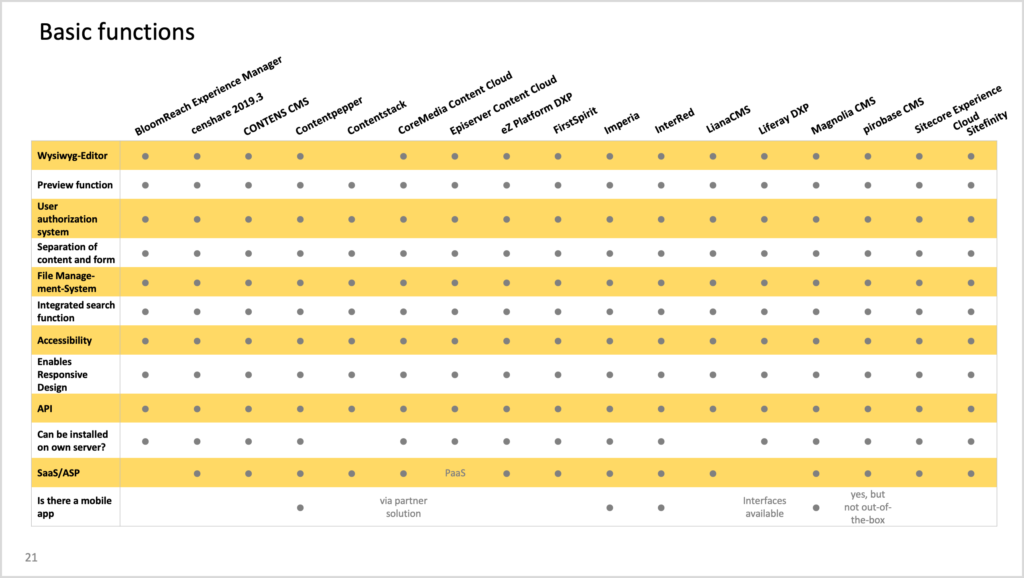
All content management systems in this overview have a wide range of functions and features. Some belong to the mandatory category, some rather to the freestyle. First of all, it can be said that all solutions are on a similarly very good level when it comes to the basic features of the tools. These include, for example, a wysiwyg editor, a user/authorization system, a file management system and responsive design. There were only a few gaps in three of the criteria queried, for example in the question about the possibility of installing the CMS on one’s own servers and whether a mobile app was available. In short, the basic functions that the user needs are on board in every CMS that is compared in the market overview. What is surprising, however, is that the providers also cover almost all of the more advanced functions – i.e. more of the freestyle – with their solutions. These functions include, for example, the possibility of personalization, workflow management, content staging or content versioning.
A CMS as a central point for content needs interfaces Important for a CMS is its ability to cooperate with other tools and solutions via interfaces. For example, are there interfaces to Google Analytics and Google Search Console? Can third-party analysis tools such as Piwik or eTracker be connected? The question of newsletter tools or external store systems (-> see also our market overview of store systems) and common social media platforms was also asked here. The result: almost everything is possible and can be integrated, but not everything is included in the functional scope of the solutions without effort or additional costs. Users should therefore look at their tool setup and check to what extent a CMS provider allows integration.
Additional functions and individualization via apps and plugins
Plugins are the salt in the soup, because they can significantly increase the functional scope of a CMS and optimize the content. Examples are automation plugins, event calendars, translation modules, landing page or form builders. Here, too, almost everything is possible with most CMS solutions, but many of them are not on board from the outset, but can be implemented via third-party providers.
Content has to be visible and a CMS has to help with that
Why produce content if it can’t be found? There is a lot of truth in this sentence. At the same time, it shows the importance of SEO criteria for a CMS – and we checked them out. The good news: all providers have very good options for presenting the content in a search engine optimized way. These include the possibility to create individual snippets, the possibility of breadcrump navigation or the prevention of duplicate content through a canonical attribute. Basically, you should check whether the SEO software that you may already be using as a stand-alone solution can be integrated into the CMS (-> see also our SEO software market overview).
Legal criteria
Of course, legal criteria are also a factor that should not be underestimated when selecting software. Especially against the background of data protection regulations, it can be relevant where the provider’s servers are located or whether there is a standardized contract for commissioned data processing. The question of certifications is also relevant in this context. Here, there are differences among the providers within the market comparison, although at the same time it must be noted that the companies are of a good standard here. By the way, there are also some legal pitfalls in the transfer of content management systems independent of the providers. Here you can find a guest article by lawyer Christian Solmecke at contentmanager.de.
Price models of the providers very different, the amount of the costs as well
Whoever chooses a CMS, of course also looks at the price. It is interesting to know what the costs of the software for a company are made up of. There are big differences here: While with some providers the costs arise primarily through the number of users or installations, with others it is the number of visitors/views that the website in question has. The model of charging according to the number of functional modules used in the solution was also mentioned. There are large differences in the minimum annual costs for the software. The range here is between EUR 4,000 and EUR 42,000 – at least among the providers who provided information on this question. In general, the providers are reluctant to specify the costs. This is the case with the question about setup costs, because the implementation of a CMS can be very complex. Here, almost all providers pointed out that these costs vary depending on the customer’s catalog of requirements.











No Comment